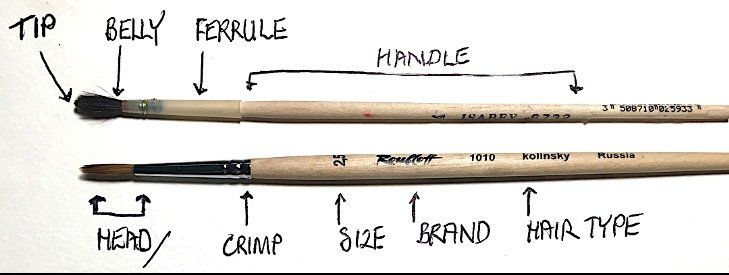
Artist’s tools
Preparatory sketches
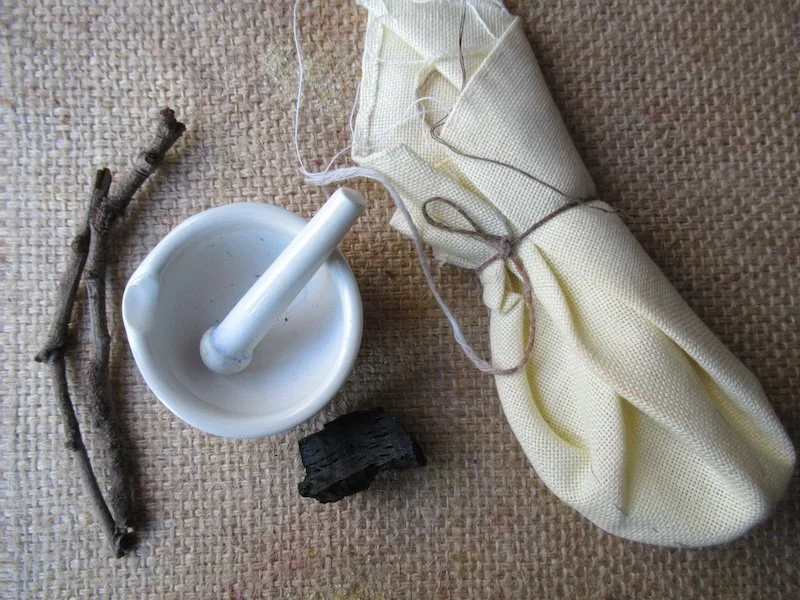
Essential tools and materials for drawing the preliminary design on the gessoed wood panel include charcoal, graphite sticks, and sepia ink using a soft brush. Cennino Cennini, in his late-fourteenth century manual Il Libro dell’Arte, instructed his students in the making of ‘willow coals’ by baking willow sticks to charcoal.
Willow coals were used to establish the initial design, either as a full-scale drawing on paper or directly onto the gessoed panel, with a feather being used as an eraser.
Early pencils used cut pieces of raw graphite dug from the earth. Their hardness or softness was solely dependent on the quality or purity of the graphite.
To transfer a paper design onto the prepared surface for the painting, pin pricks were scored along the design lines on the paper. A fabric bag of charcoal dust was then ‘pounced’ through the holes so as to transfer the design onto the prepared ground of the panel or wall.
Paint brushes
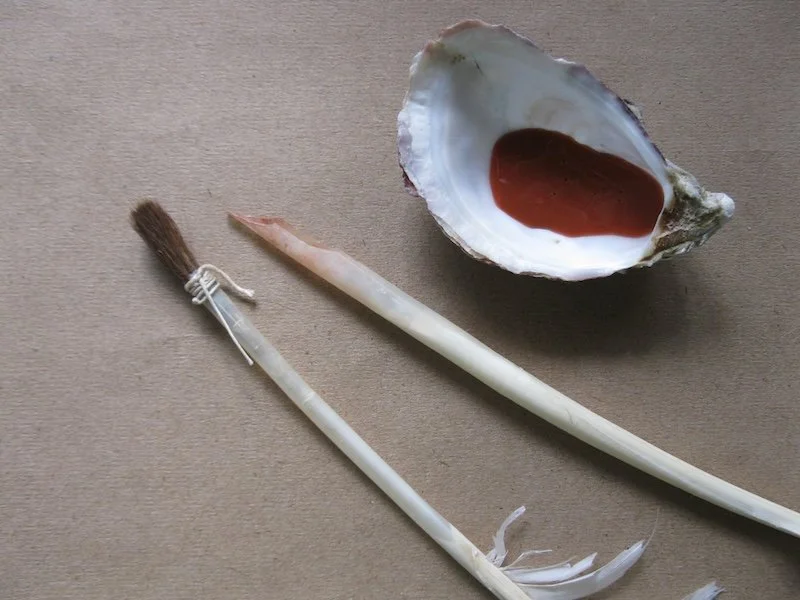
Traditionally, paint brushes were hand-made from naturally sourced materials. Cennino Cennini (pp.40-41) advised the use of the diverse hairs of a minever tail, making bunches of various sizes and binding them into the hollow of either a hen or dove’s feather. For larger and stronger brushes, a white hog’s bristles were bound into a goose quill.
Brushes designed for watercolour painting are the most suitable type for working in egg tempera. A variety of shapes and sizes are available, enabling a diverse range of expressive and descriptive marks. Natural hair brushes made from animal hair or fur (sable, Kolinsky mink, badger), sit alongside a range of good synthetic substitutes as well as those made with a mix of synthetic and natural hairs.
Egg tempera painting brushes need to produce a variety of fine and expressive lines, large soft-edge washes (glazes), as well as controlled layering of flat hard or soft-edge shapes.
Brush qualities entail the capacity to hold liquid paint and the ability to spring back to the original shape.